PMP Premium News
2024.10.25
- Labor administration: Trends
Are Japan’s dismissal regulations not strict compared to international standards?

During the recent LDP leadership election, a female candidate known for her strong conservative views remarked that “Japan’s dismissal regulations are not that strict when compared internationally.” Her statement seems to be based on the OECD Employment Protection Legislation (EPL) indicators.
I apologize for the somewhat hard-to-read graph below, but it is an international comparison from the OECD regarding the dismissal regulations for regular employees and fixed-term contract workers. The vertical axis represents regulations for fixed-term workers, and the horizontal axis represents regulations for regular employees. Higher values indicate stricter regulations, while lower values suggest more lenient regulations.
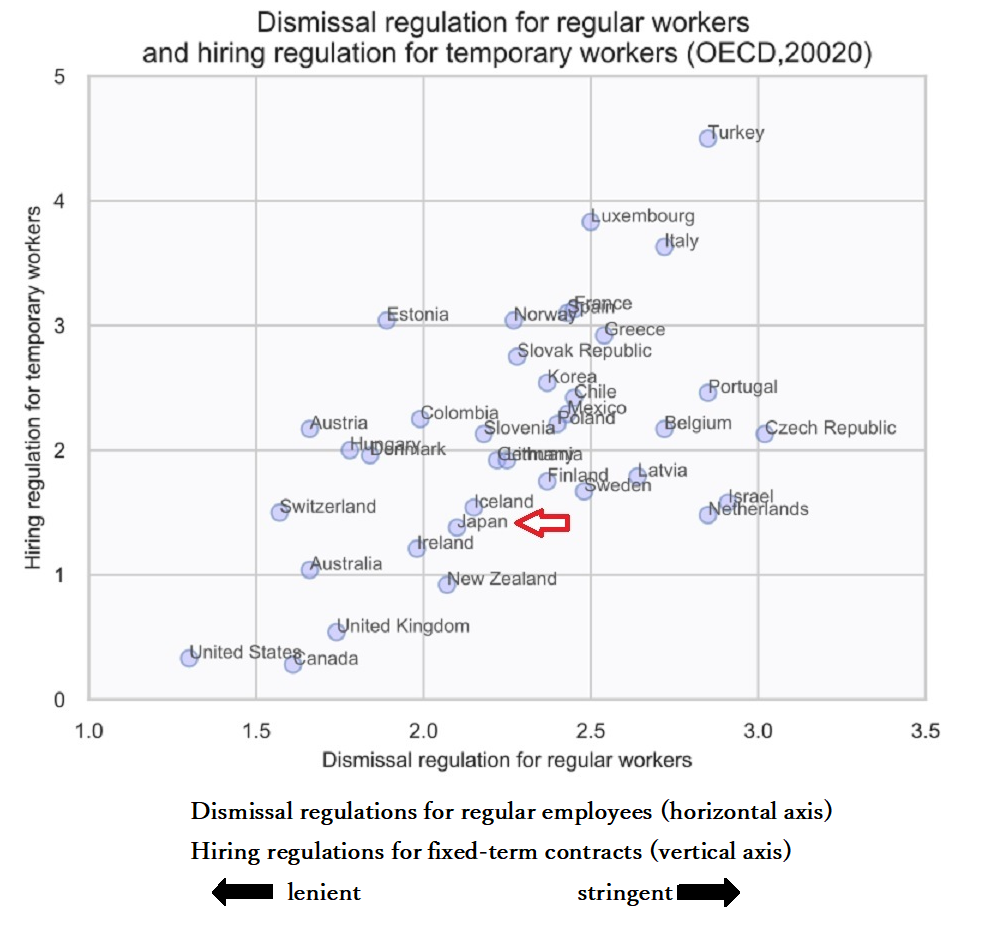
Now, can you spot Japan? I’ve marked it with an arrow, positioned between Ireland and Iceland. From this overview, it does seem that Japan’s dismissal regulations are slightly more lenient compared to the OECD average. So, is the female candidate’s view correct?
I delved a bit deeper into this survey. The OECD appears to have set 24 specific indicators for dismissal regulations and used these to assess the labor laws of OECD countries. When I checked the specific items for Japan in the OECD’s survey, the results for some items were as follows:
- Notice period for dismissal: Employers are required to give at least 30 days’ notice or pay an average wage equivalent to 30 days or more. Verbal notice is sufficient, and a written explanation of the reason for dismissal is provided only if requested.
- Dismissal notice period based on length of service: No specific regulations exist in Japan that adjust the notice period based on the employee’s length of service. Regardless of tenure, the notice period remains 30 days.
- Severance pay based on length of service: In Japan, there is no legal obligation to pay severance based on length of service.
If one interprets these three results literally, it’s easy to conclude that Japan’s dismissal regulations are quite lenient.
However, we know the reality. These OECD survey results are based on Japan’s Labor Standards Act, but the Act itself is not sufficient to address dismissals in Japan. In practice, can an underperforming employee really be dismissed with just 30 days’ pay? No one would agree with this. First, in Japan, the reasons for dismissal are rigorously examined, and efforts to avoid dismissal are repeatedly reviewed. Even when dismissal becomes possible after such scrutiny, it is customary to provide special severance pay. This severance is based on length of service, with longer tenure generally resulting in higher severance amounts. At PMP (My consulting firm: People Management Professionals), when consulting on dismissal cases for companies, we advise that at least one month of severance per year of service, with a of three months, should be provided. Furthermore, when the case goes to court, severance expectations tend to rise. This is the reality, but such practices are not mentioned anywhere in the Labor Standards Act or other labor laws in Japan.
On a side note, what frustrates me most is that the person who cited this OECD survey to outmaneuver her rival candidate holds the position of a member of the Diet, the highest legislative body in our country.
Latest articles in the same category
-

-
2023.07.27
- Labor administration: Trends
Overview of The Basic Policy on Gender Equality and Empowerment of Women 2023
On June 5, the Government of Japan held the Council for Gender Equality and announced the so-called "Women's Version of the Framework for Gender Equality 2023". And we would like to take this opportun…
-

-
2022.04.22
- Labor administration: Trends
A large multinational consulting Company has been sent to the Prosecutors Office for Violation of the Labor Standards Act.
As the issue of overtime and working hours continues to gain a lot of attention in Japan we would like to bring to your attention an ongoing case and the issues around overtime exemptions in Japan. …
-

-
2021.04.28
- Labor administration: Trends
Health Management and Prevention of COVID-19 in the Workplace through the State of Emergency
With the announcement of the Third State of Emergency the Ministry of Health Welfare and Labour distributed the following guidelines to organisations through Keidanren, the business association. …
-

-
2021.02.19
- Labor administration: Trends
Employment of people with disabilities
The legally mandated employment rate for disabled people will increase from 2.2% to 2.3% on March 1, 2021.Initially, the increase was scheduled to take effect on January 1, 2021, but due to the i…
-

-
2021.02.05
- Labor administration: Trends
If you use the secondment to avoid dismissal by Corona, you can get a subsidy for 2/3 to 9/10 of wages by Japanese government
Secondment, is a kind of employment that is widely accepted in Japan.A simple explanation of how it works is as follows.1 Two companies sign a secondment contract.2 The original employer is the…